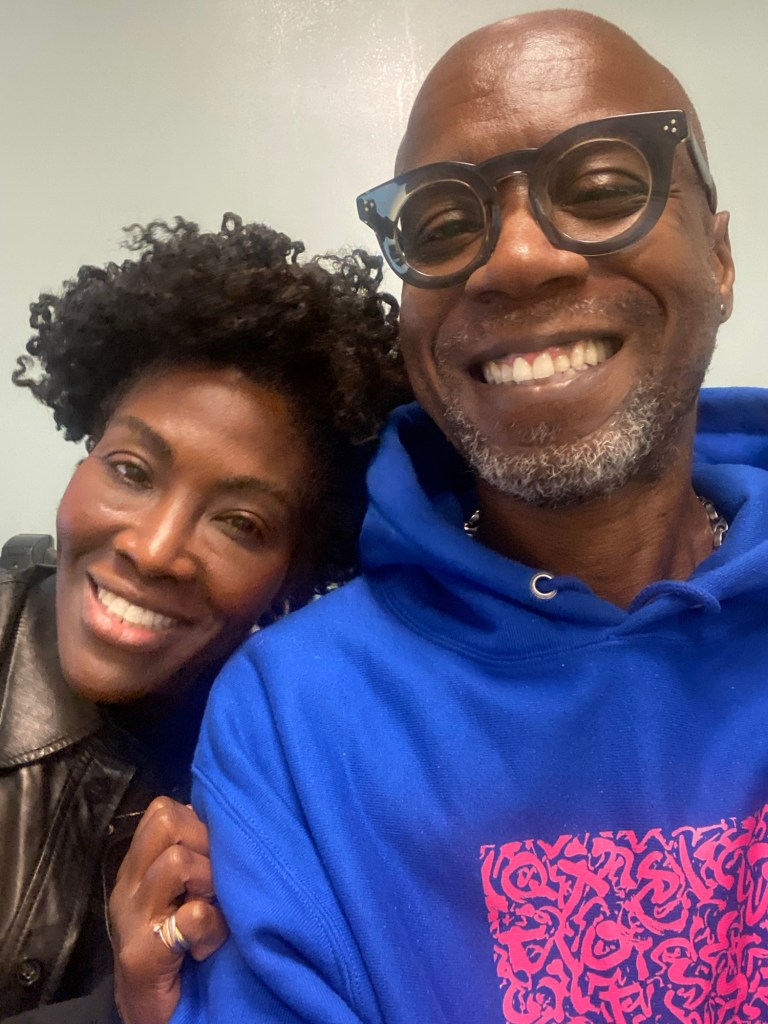
I never dreamed I’d see the day when both of my eyes were in permanent alignment—but here we are. It’s a subtle shift to most people, barely noticeable in a photo. But to me, it’s monumental. For the first time in my life, I can look in the mirror and not flinch. I can hold eye contact without second-guessing whether the person I’m speaking to is trying to figure out which eye is “off.” I feel aligned, not just physically—but emotionally.
The person I have to thank for that is Dr. Tamiesha Frempong, who did more than restore ocular symmetry—she gave me back the confidence I should’ve had decades ago. She gave me the care, the language, and the follow-through I’d been denied as a child.
When I was young, my eye condition—amblyopia, sometimes referred to as “lazy eye”—was visible, diagnosable, and treatable. But it went unaddressed. Dr. Gerard B. Kara, the (white) ophthalmologist I saw at the time, dismissed it. He never named it, never treated it, never suggested a plan. My parents trusted him. I was too young to advocate for myself. And so, I grew up with a wandering eye and the stigma that came with it—assumptions about intelligence, attentiveness, appearance.
Dr. Kara is now dead, so I can’t exhume him and desecrate his corpse. But I can call out the medical racism embedded in his failure to diagnose and treat me.
It’s a strange kind of grief, realizing what might have been prevented if someone had simply seen me fully and cared enough to act. I often wonder: would I have spoken up more in class if I didn’t feel self-conscious about my eye? Would I have felt more desirable? Would I have taken up more space?
But regret isn’t the emotion that dominates. Gratitude is. At this age, I’m finally able to appreciate the miracle of what Dr. Frempong has done—not just surgically, but holistically. She explained everything clearly. She listened. She understood the emotional weight of something many doctors might’ve dismissed as “cosmetic.” And when I woke up from that final surgery, something in me felt corrected—not just my gaze, but the years of dismissal that preceded it.
Everything happens for a reason and at the right time, I suppose. Still, I can’t help but think that maybe—just maybe—this moment of alignment was a long-overdue course correction, one that should have happened in childhood.
But it happened now. And now, I see clearly.
 Bohemian Dork
Leave a comment